Video - advanced commands
HTML animated presentations using scenes
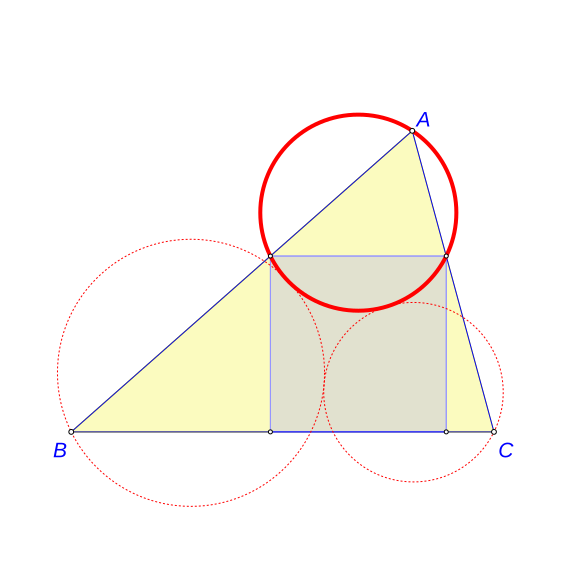
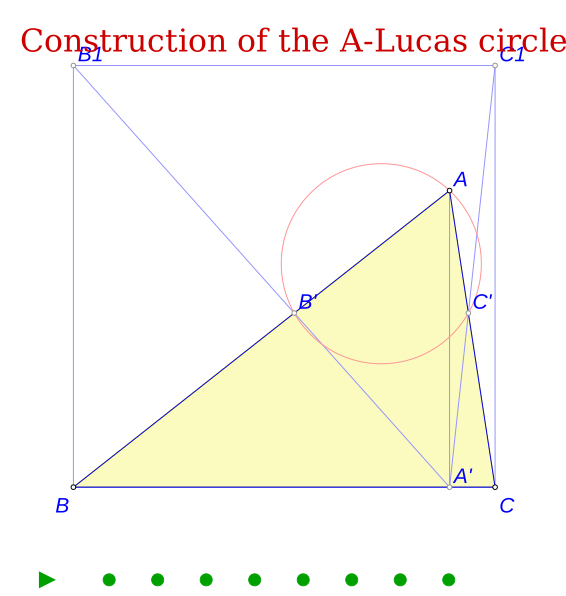
-
How to use scenes to show the construction steps for A-Lucas circle. (video.mp4)?
-
How to use scenes to show some observed properties of the A-Lucas circle. (video mp4)?
-
How to use scenes to show objects added to Lucas circles. (video mp4)?
-
How to visualise scenes in the construction view (video mp4)?
-
How to visualise and comment scenes in the project view (video.mp4)?
-
How to create a HTML report with animated figures (video.mp4)?
-
To create a report showing scenes as figures use the report style Scenes (mosaic).
Analysis of generic constructions
We demonstrate how to analyse generic constructions using a simple generic construction. It consists of a triangle ABC and two rules.
The first rule specifies possible constructions for the point P: P can be any of the first 16 Kimberling centres of triangle ABC.
The second rule specifies possible constructions for the points A' with respect to triangle PBC, B' with respect to triangle PCA, and C' with respect to triangle PAB. The points A', B', and C' can each be any of the first 16 Kimberling centres of their respective triangles.
This generic construction thus comprises 16 × 16 = 256 examples.
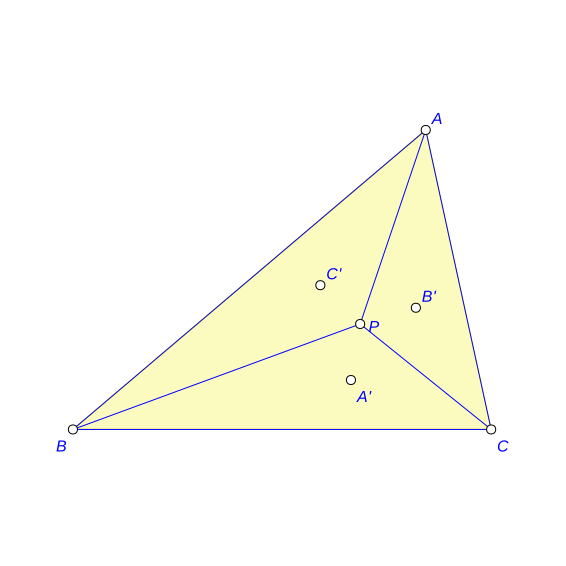
-
Some remarks on generic constructions (video.mp4).
-
How to create a generic construction? A step-by-step explanation of how to create the above generic construction (video.mp4)
-
How to analyse individual examples of a generic construction. Here we explain how to visualise and perform various types of analysis on any of the 256 examples of our generic construction (video.mp4).
-
How to select examples that satisfy the conditions criterion? We show how to select examples in which the points A, B, C, A', B', C' are coconical (video.mp4).
-
How to select examples that satisfy the properties criterion? Here we show how to select examples in which there are pairs of tangent circles through three points. (video.mp4).
-
How to analyse all examples or a selection of examples? Here we show how to observe formulae and perform triangle analysis on a selection of examples of a generic construction. We also show how to store examples as icons of a project or items of an archive.(video.mp4).
Observing proofs of properties
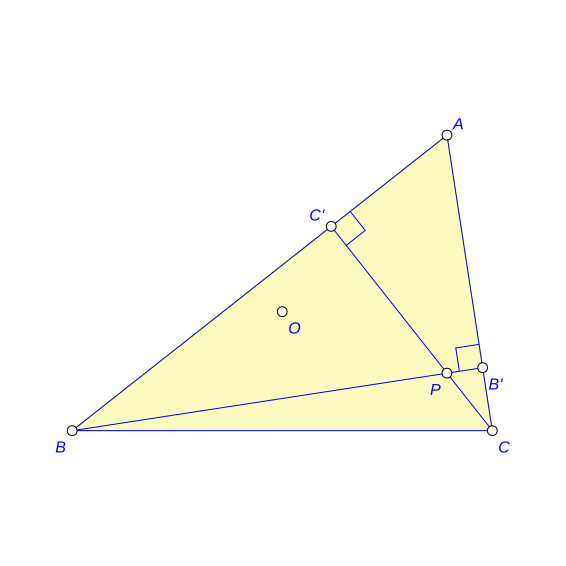
OK Geometry incorporates a prover that is based on the GDD method of proving. Here we demonstrate how to perform simple and somewhat more complex proofs. We also use the GDD-prover to identify 'difficult' proof tasks, considering the inability to obtain a GDD proof of proof task as a criterion for task 'difficulty'.When demonstrating the use of the GDD prover, we will use the following simple geometric configuration:
Given is a triangle △ABC. Let O be its circumcentre and let B' and C' be the feet of the B- and C-altitude.
-
Create the configuration described above (video.mp4).
-
How to perform a simple proof? To demonstrate this, we prove that AP ⊥ BC (video.mp4).
-
How to perform a proof that requires adding a point to the configuration? To demonstrate this, we prove that B'C' ⊥ AO (video.mp4).
-
How to identify 'difficult-to-prove' properties of a configuration? We perform this on the configuration described above (video.mp4).
-
How to generate examples of 'difficult' proving tasks by adding new objects to a given configuration? We demonstrate this by identifying 'difficult' properties that involve the midpoints as an additional point in our configuration (video.mp4).